
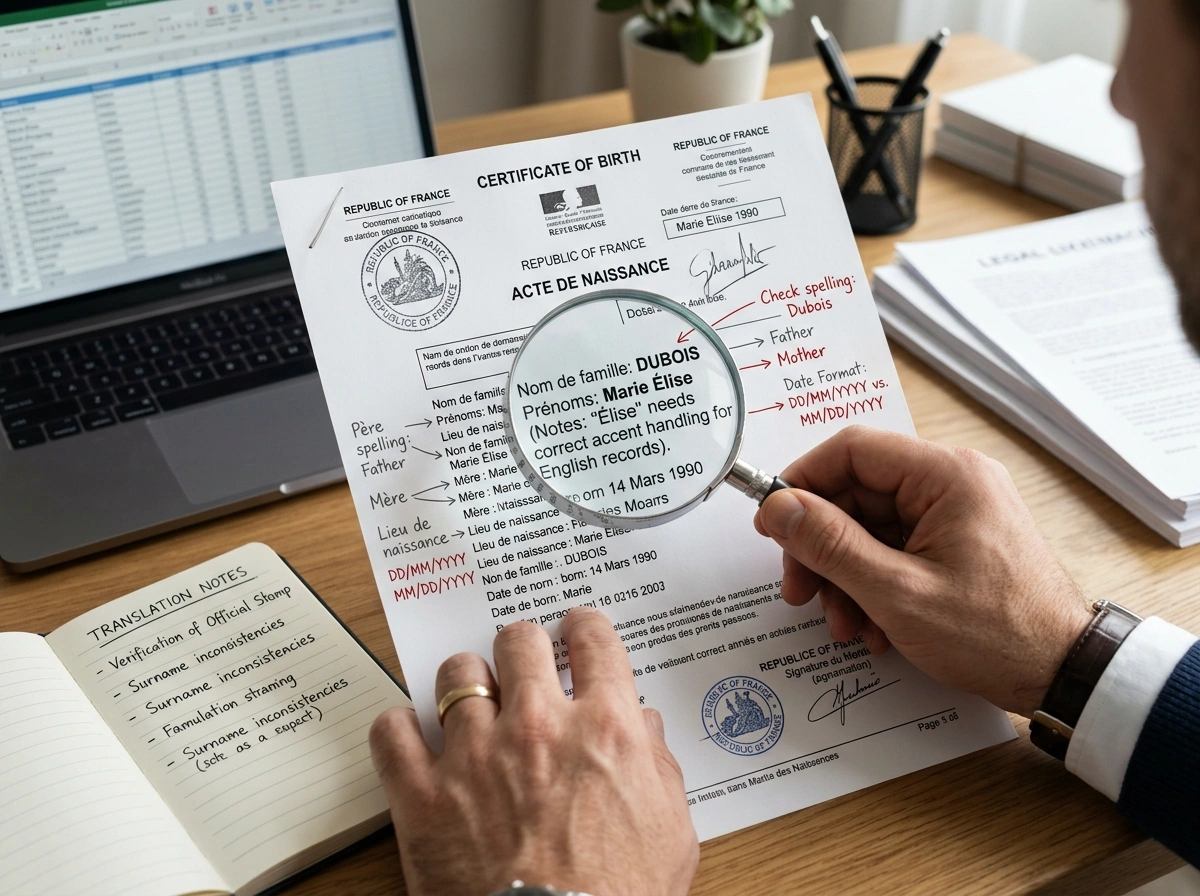
Navigating Birth Certificate Translation Challenges
A birth certificate is much more than a simple piece of paper. It serves as the foundational document of your identity, establishing your name, age, origin, and citizenship. When you move across international borders, this single document becomes the key to unlocking vital opportunities. From applying for a visa or green card to enrolling in a foreign university or getting married abroad, local authorities will inevitably request proof of your birth.
When the original document is in a language different from the official language of your destination country, a direct, certified translation becomes a strict requirement. The process of converting this vital record is far from straightforward. Translators must capture the exact meaning of the original text while adhering to rigid formatting and legal standards set by foreign governments and immigration agencies.
Failing to meet these strict criteria can result in severe consequences. A mistranslated name, an overlooked stamp, or an incorrect date format can trigger immediate application denials, prolonged processing times, and unnecessary financial burdens. Understanding the complexities involved in the translation process empowers individuals to prepare their documents correctly and avoid bureaucratic nightmares.
This guide explores the most frequent obstacles encountered when translating vital records and provides actionable strategies to ensure your documents are accepted by government agencies, educational institutions, and legal bodies worldwide.
Why Accuracy and Certification Matter
Government agencies and legal institutions operate with zero tolerance for ambiguity. When dealing with vital records, officials must verify that the information presented is a flawless reflection of the original document. A minor typographical error in a name or a slight misinterpretation of a location can completely derail an immigration case or a legal proceeding.
Accuracy extends beyond simply swapping words from one language to another. It requires a profound understanding of legal terminology and administrative formatting. Translators must ensure that every date, title, and institutional name aligns perfectly with the target country’s expectations.
Furthermore, simply translating the text is rarely enough. Most official institutions, such as the United States Citizenship and Immigration Services (USCIS), require a certified translation. This means the translator or translation agency must attach a formal statement verifying their competency to translate the source language into the target language. This certificate of accuracy acts as a guarantee that the translation is complete and precise, bearing the signature of the professional who completed the work. Without this certification, the document holds no legal weight in official contexts.
Common Hurdles in the Translation Process
Translating historical and administrative records presents a unique set of obstacles. Documents from different decades and countries vary wildly in their design, legibility, and linguistic conventions.
Deciphering Handwritten Text
Many older birth certificates, and even some modern ones from specific regions, feature handwritten entries. Over time, ink fades, paper degrades, and cursive handwriting can become incredibly difficult to decipher. A translator might struggle to distinguish between a hastily scribbled ‘m’ and an ‘n’, or decipher a signature that looks like a continuous loop. Misreading a single handwritten letter in a parent’s surname can invalidate the entire translated document. Translators often have to rely on context clues, specialized knowledge of regional naming conventions, and sometimes even digital enhancement tools to accurately read the source text.
Replicating Stamps, Seals, and Watermarks
Official documents derive their authority from stamps, embossed seals, signatures, and watermarks. A translation must account for every single visual element present on the original page. Translators cannot simply ignore a faint stamp in the margin; they must describe it. You will often see bracketed descriptions like “[Round seal of the Ministry of Interior]” or “[Illegible signature]” on a professional translation. Accurately describing these elements without confusing the reader requires a methodical approach and a strict adherence to formatting guidelines.
Navigating Regional Dialects and Antiquated Terms
Languages are living entities that evolve over time and vary significantly across geographic regions. A birth certificate issued in rural Mexico in 1950 will use different terminology than one issued in Madrid in 2020. Administrative titles, geographical regions, and hospital classifications change. A professional translator must possess the cultural and historical knowledge to accurately convert outdated or highly localized terms into a format that a modern immigration officer will immediately understand.
Meeting Strict Legal and Regulatory Requirements
Every country and institution has its own specific set of rules regarding accepted document translations. Navigating this bureaucratic maze is often the most stressful part of the process for applicants.
In the United States, USCIS mandates that all foreign language documents must be accompanied by a full English translation. The translator must certify that the translation is complete and accurate, and that they are competent to translate from the foreign language into English. USCIS does not require the translator to be a certified professional, but utilizing an uncredentialed individual vastly increases the risk of rejection due to formatting errors or inaccurate terminology.
Other institutions may have even stricter requirements. Some universities or foreign courts require notarized translations, where a notary public verifies the identity of the person signing the certificate of accuracy. For documents destined for use in countries that are part of the Hague Convention, an Apostille might be necessary. An Apostille is an additional form of authentication that verifies the origin of the document and the authority of the official who signed it. Understanding exactly what your receiving institution requires is the critical first step before initiating any translation work.
Practical Strategies to Overcome Translation Challenges
While the challenges are numerous, there are specific steps you can take to facilitate a smooth translation process and ensure your documents are accepted without delay.
First, always obtain the clearest possible copy of your original document. If you are scanning the certificate, ensure the scanner is set to a high resolution. All edges, stamps, and signatures must be entirely visible. If a portion of the document is cut off or blurry, the translator will be forced to mark it as illegible, which could trigger a rejection from the receiving agency.
If your document contains highly stylized handwriting or extremely unusual regional names, provide a supplementary note to the translator. If you know the exact spelling of a difficult-to-read hometown, sharing this information upfront prevents guesswork and potential errors.
Always verify the specific requirements of the institution receiving your documents. Check their official website or contact their support team to confirm if they need a standard certified translation, a notarized copy, or an Apostille. Gathering this information early prevents the need for costly and time-consuming revisions later on.
The Role of Professional Translation Services
Given the high stakes involved in immigration, legal, and academic applications, attempting a DIY translation or relying on bilingual friends is a substantial risk. Partnering with a specialized agency eliminates the guesswork and provides peace of mind.
Professional agencies employ native speakers and members of recognized organizations like the American Translators Association (ATA). These experts understand the exact phrasing and formatting expected by global authorities. When you utilize a professional service for birth certificate translation, you benefit from their experience handling thousands of similar documents.
Established services also offer transparent pricing and structured workflows. For example, many reputable agencies offer clear per-page pricing, such as $29.95 for standard pages, and provide specialized add-ons for documents with heavy handwriting or those requiring notarization and Apostille services. They also possess the resources to handle urgent requests, offering expedited processing for applicants facing strict deadlines. By trusting professionals, you ensure your vital records are translated with precision, formatted correctly, and guaranteed to be accepted by institutions like USCIS.
Frequently Asked Questions (FAQ)
What exactly is a certified translation?
A certified translation includes a formal signed statement from the translator or translation agency. This statement attests that the translation is a true, accurate, and complete representation of the original document. It also confirms the translator’s fluency in both the source and target languages.
Can I translate my own birth certificate for USCIS?
No. USCIS guidelines state that the individual submitting the application cannot translate their own documents, even if they are entirely fluent in both languages. The translation must be completed by a competent third party to maintain objectivity and prevent fraud.
How are illegible stamps or faded text handled?
When a professional translator encounters text, signatures, or stamps that are completely unreadable due to document damage or poor copy quality, they will insert a bracketed note indicating the issue. For example, they might write “[illegible text]” or “[faded stamp]”. It is always best to provide the highest quality scan possible to minimize these occurrences.
Do I need to send my original physical document to the translator?
In most cases, you do not need to surrender your original physical document. Professional translation agencies typically work from high-quality digital scans or clear photographs of the original record. You will, however, need to submit a photocopy of the original document alongside the certified translation when filing your official application.
Securing Your Global Future with Precise Translations
Moving abroad, advancing your education, or adjusting your legal status requires meticulous preparation. Your birth certificate is the anchor of these applications. Treat its translation with the seriousness it demands.
By understanding the challenges of deciphering historical formatting, navigating regional dialects, and meeting strict legal requirements, you can approach the translation process proactively. Secure high-quality digital copies of your records, clarify the specific requirements of your receiving institution, and seek out established professionals who specialize in vital records. Taking these decisive steps ensures your paperwork sails through administrative reviews, allowing you to focus on the exciting opportunities awaiting you across borders.
